Community Dynamics
Community dynamics examines how plankton assemblages form, interact, turn over, and respond to changing ocean conditions. Plankton rarely occur as isolated species; they form communities whose members compete, coexist, respond to shared environmental conditions, and support different parts of the marine food web. The ecological role of a plankton community depends not only on how much biomass is present, but also on which organisms make up that biomass. A bloom dominated by one group can have different consequences for food webs, carbon export, nutrient cycling, or harmful bloom risk than the same amount of biomass distributed across many taxa. High-frequency plankton imaging makes it possible to study communities as dynamic assemblages that reorganize across water masses, seasons, and years, so we examine both “how much is there” and “who is there” as complementary signals of ecosystem change.
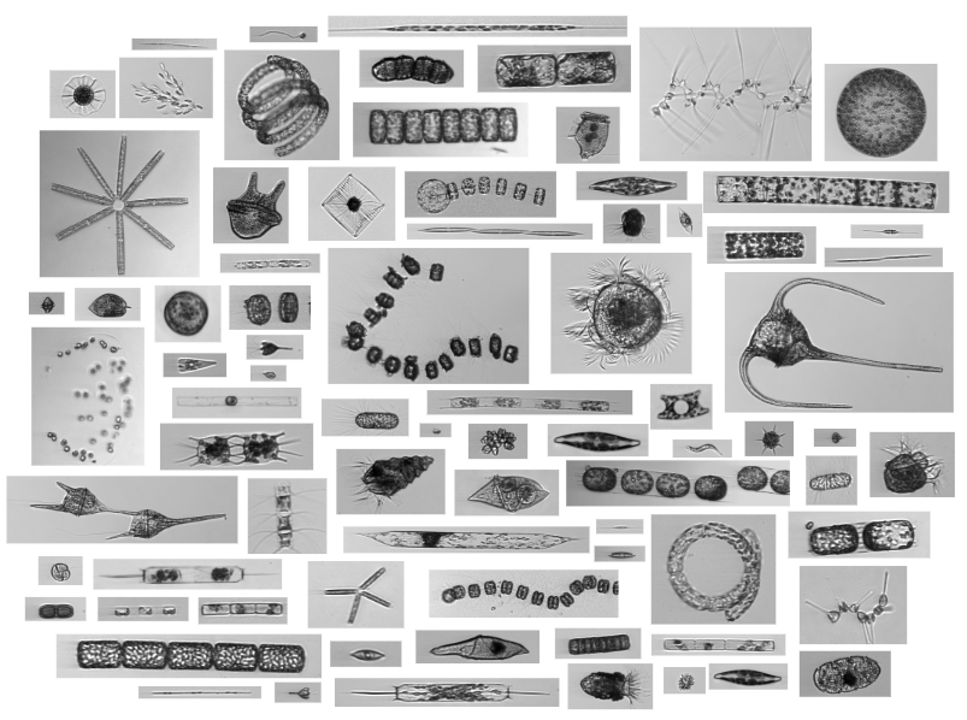
Imaging FlowCytobot (IFCB) images show the morphological diversity of phytoplankton and microplankton. Each image is a small biological observation, and automated classification can turn thousands of images into taxonomic, biovolume, and carbon-based community data. That makes it possible to measure community change across seasons, years, and water masses at a scale that would be difficult with microscopy alone. Credit: Sosik Lab @ WHOI.
Through the Northeast U.S. Shelf Long-Term Ecological Research (NES-LTER) program, we study spatial, seasonal, and interannual variability in phytoplankton biomass and community composition across a cross-shelf transect from nearshore waters to the shelf break. Metacommunity analyses help separate local variability from regional variability and distinguish aggregate change in total biomass from compositional turnover in the taxa present. Communities can appear synchronized in total biomass while becoming less synchronized in composition, or vice versa, revealing whether the shelf is changing as a coherent region or as a set of locally distinct habitats. We also use topic-modeling approaches to identify recurring assemblages within complex image-based plankton datasets, treating each sample as a mixture of community patterns rather than a single fixed category.
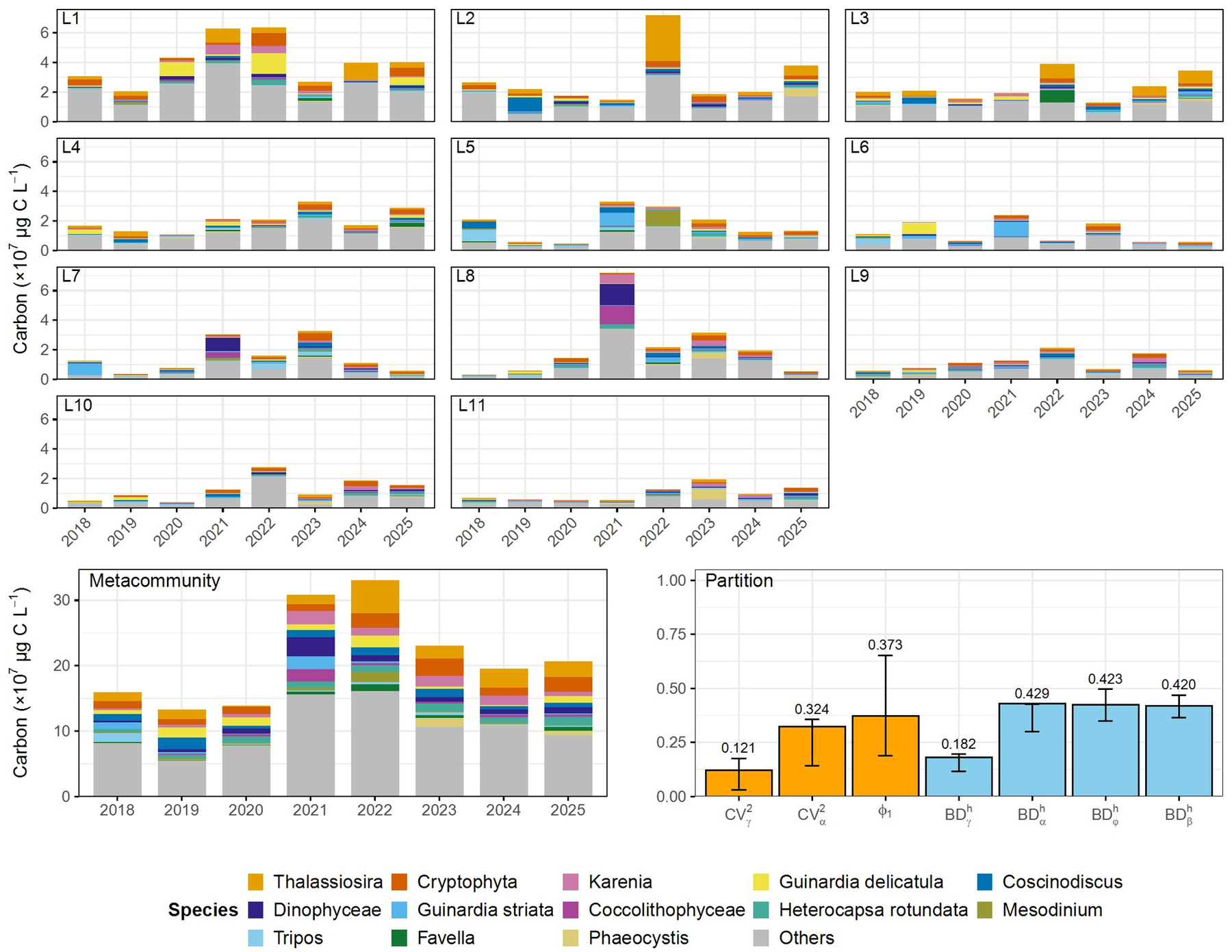
Metacommunity analysis of Imaging FlowCytobot observations separates variability in total phytoplankton biomass from variability in community composition. This distinction helps show whether change is driven mainly by more or less plankton overall, by shifts in which taxa are present, or by differences in how synchronized communities are across the Northeast U.S. Shelf.
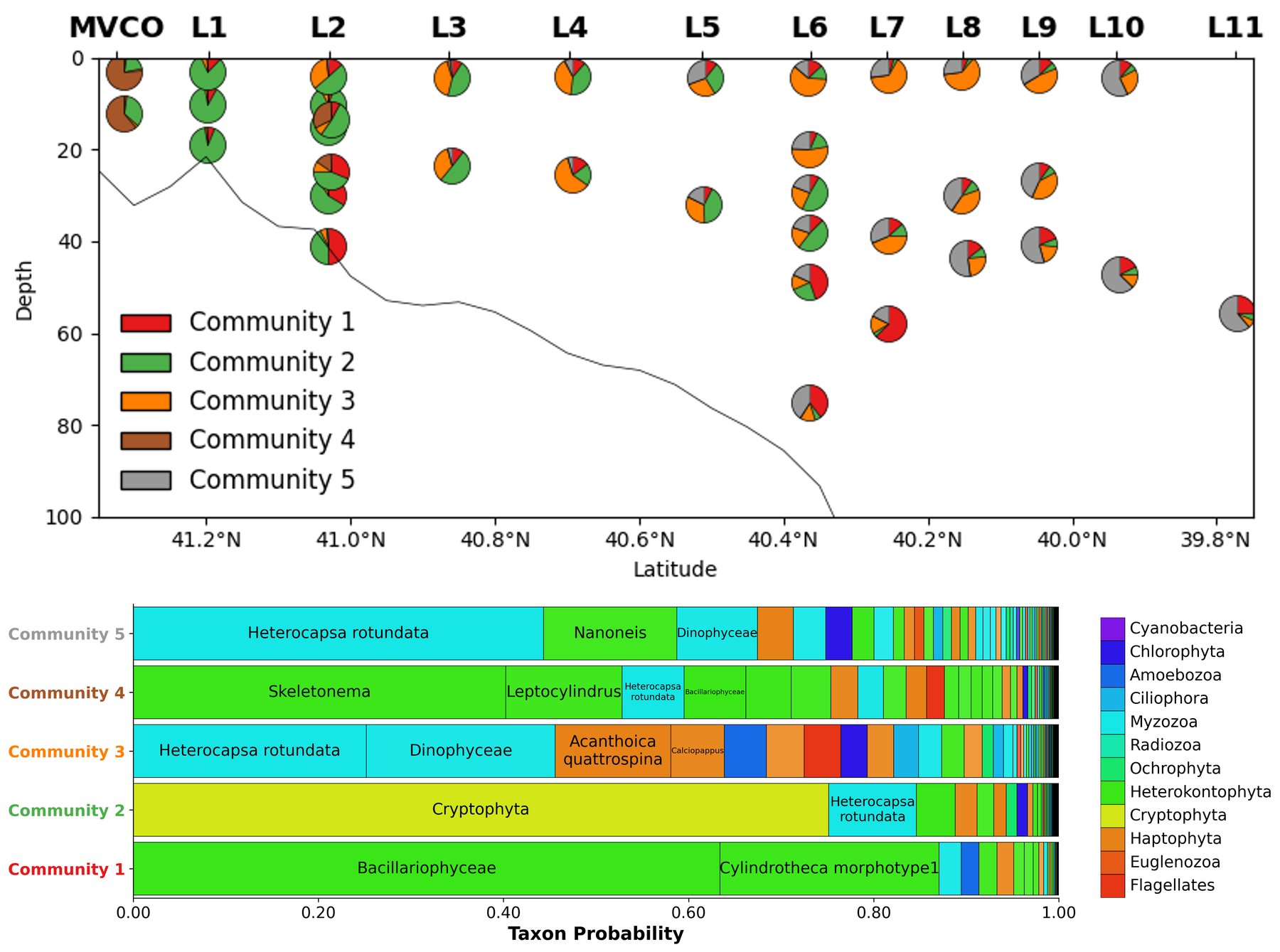
A natural-language-processing approach, similar to Latent Dirichlet Allocation (LDA), represents each plankton sample as a mixture of recurring assemblages. This is useful for studying community dynamics because samples often contain overlapping communities rather than clean, mutually exclusive groups. Topic modeling can reveal which organisms tend to appear together across depth, latitude, and environmental gradients while preserving that mixture structure.